
Uncategorized
CBD Oil Dosage Australia — How Much Should I Take

Jun
General Guide · Lab-tested · Start Low, Go Slow
CBD Oil Dosage Australia — How Much Should I Take
Common starting points, body-weight ranges and goal-based dosing for CBD oil in Australia — within the Schedule 3 framework. General information, not medical advice. Talk to your GP before starting any new wellness product.
✓
Lab-Tested
Every batch, ISO-accredited
🌿
Ships Across AU
Tracked direct delivery
🚚
Free Shipping
On orders over $100
↺
30-Day Returns
If it’s not right for you
General information — not medical advice
The ranges on this page are general starting points commonly published by CBD manufacturers and clinicians — not personalised medical advice. Individual response varies. Always speak with your GP or pharmacist before starting CBD, especially if you take prescription medication, are pregnant or breastfeeding, or are managing a medical condition.
The short answer
Most adults commonly start with 5–10 mg of CBD once or twice daily, then increase by 5–10 mg every 3–5 days until they reach a level that supports their goal. Daily ranges typically published sit between 10 mg (light) and 150 mg (the Schedule 3 over-the-counter ceiling in Australia). Anything higher requires a Schedule 4 prescription via a GP or Authorised Prescriber.
How much CBD oil should I take?
There is no universal “correct” CBD dose. Common starting points published by manufacturers and clinicians sit at 5–10 mg of CBD once or twice daily, scaled up by 5–10 mg every 3–5 days until you reach the level that supports your goal. In Australia, Schedule 3 caps over-the-counter CBD at 150 mg per day; higher amounts move into Schedule 4 prescription territory.
Start low, go slow — the universal method
The starting point most CBD educators and clinicians publish is 5–10 mg, taken once or twice daily for 3–5 days. If you don’t feel a meaningful difference at that level, add another 5–10 mg and hold there for another 3–5 days. Repeat until you reach a level that supports your goal, then plateau there. This “start low, go slow” approach is the same harm-reduction framework used across most supplement and wellness categories — it minimises side effects (drowsiness, dry mouth, mild GI upset) while letting you find your individual responsive dose.
Why a one-size dose doesn’t exist
Individual response to CBD varies significantly. The main drivers are body weight, baseline endocannabinoid tone, metabolism (the CYP450 liver pathway in particular), the goal you’re using CBD for, and the format you choose. A 60 kg first-time user looking for evening wind-down might feel meaningful effects at 10 mg sublingually; a 95 kg long-time user managing post-training soreness might not notice anything below 25 mg. Both ranges are common — neither is wrong.
The Schedule 3 ceiling — 150 mg/day OTC in Australia
Australian regulation caps over-the-counter CBD at 150 mg per day under Schedule 3. Below that ceiling, hemp-derived low-THC CBD oil can be purchased without a prescription from established direct-to-consumer brands like Krush. Above 150 mg per day, or for any meaningful-THC formulation, you’ll need a Schedule 4 prescription via a GP, an Authorised Prescriber, or the TGA’s Special Access Scheme. For most everyday wellness use the OTC range is more than sufficient — read the full breakdown on our Australian CBD law guide.
General CBD dosage by body weight
Body weight is one input among several. The table below shows general daily-range tiers typically used in wellness contexts — light for first-time users or light-sensitivity goals, moderate for established daily use, and high for users managing more intense recovery or stress loads. Individual response varies hugely; always start at the lower end of the tier and work up.
| Body weight | Light range | Moderate range | High range (within Schedule 3) |
|---|---|---|---|
| Under 60 kg | 5–15 mg/day | 15–30 mg/day | 30–60 mg/day |
| 60–90 kg | 10–25 mg/day | 25–60 mg/day | 60–100 mg/day |
| 90 kg+ | 15–30 mg/day | 30–75 mg/day | 75–150 mg/day |
The “high” tier intentionally stops at 150 mg/day — the Schedule 3 OTC ceiling in Australia. Anything above that requires a Schedule 4 prescription and is something your GP would manage, not something you’d self-titrate to.
Goal-based starting dose — sleep, stress, pain, recovery
The dose that supports sleep is different from the dose that supports post-training recovery, and both differ from a steady daytime stress-management dose. The table below pairs common goal-based starting points with the Krush formula typically used for each. Ranges shown are general starting points commonly published — not prescriptions.
| Goal | Common starting dose | Common daily range | Krush formula typically used |
|---|---|---|---|
| Sleep / evening wind-down | 10–25 mg, ~45 min before bed | 10–50 mg/day | Krush Night Time |
| Stress / mood support | 10–20 mg in the morning | 10–60 mg/day | Krush Daily |
| Muscle soreness / recovery | 15–25 mg post-training | 15–75 mg/day | Krush Recovery |
| Whole-day baseline | 5–10 mg AM + 10–25 mg PM | 15–75 mg/day | Day-Night Duo |
For goal-specific protocols, see our deeper guides on CBD for sleep, CBD for anxiety, and CBD for muscle soreness and recovery. Each page covers the goal-specific stack, the timing window, and the Krush formula most commonly chosen for it.
How long does CBD oil take to work?
Sublingual CBD oil — held under the tongue for 60–90 seconds before swallowing — typically takes 15–30 minutes to start working, with peak effects at 60–90 minutes and total duration of 4–6 hours. Swallowed CBD (capsules, gummies, oil mixed into food) takes longer to onset because it passes through the digestive system, but lasts longer once it does.
| Format | Onset | Duration | Approx. bioavailability |
|---|---|---|---|
| Sublingual oil (under tongue 60–90 s) | 15–30 min | 4–6 hrs | 13–35% |
| Oral (swallowed / capsule / gummy) | 45–90 min | 4–8 hrs | 6–15% |
| Topical cream | 10–20 min (local) | 3–5 hrs (local) | n/a — local effect only |
When should you take CBD oil?
Most people structure CBD around their day rather than dosing reactively. The four common timing windows below cover the goals CBD is most often used for in Australia. You can use one, stack two, or build a full day-and-night routine — whichever matches your need.
Morning routine — 5–15 mg with breakfast
A light morning dose is most commonly used by people supporting steady daytime focus and mood. Sublingual, taken with or just after the first meal of the day, the effect typically settles in by mid-morning. Krush Daily is the isolate-based formula most often chosen here — zero THC, clean taste.
Pre-bed — 10–25 mg, 30–45 min before sleep
For evening wind-down, 10–25 mg taken sublingually 30–45 minutes before bed is the most commonly published timing. Krush Night Time is formulated specifically for this window. Many users pair it with a wind-down routine — reduced screen use, lower light, no late caffeine.
Around stress moments — 5–10 mg sub-lingual ~30 min ahead
If you have a known stress trigger — a presentation, a flight, a difficult conversation — a small sublingual dose 20–30 minutes ahead is the timing pattern most often used. It is associated with feelings of calm without sedation at typical wellness ranges.
Post-workout / recovery — 10–25 mg with a meal
After training, 10–25 mg taken sublingually or with the post-workout meal supports the recovery window most people use CBD for. Krush Recovery is the broad-spectrum formula most commonly chosen for post-exercise soreness and joint discomfort.
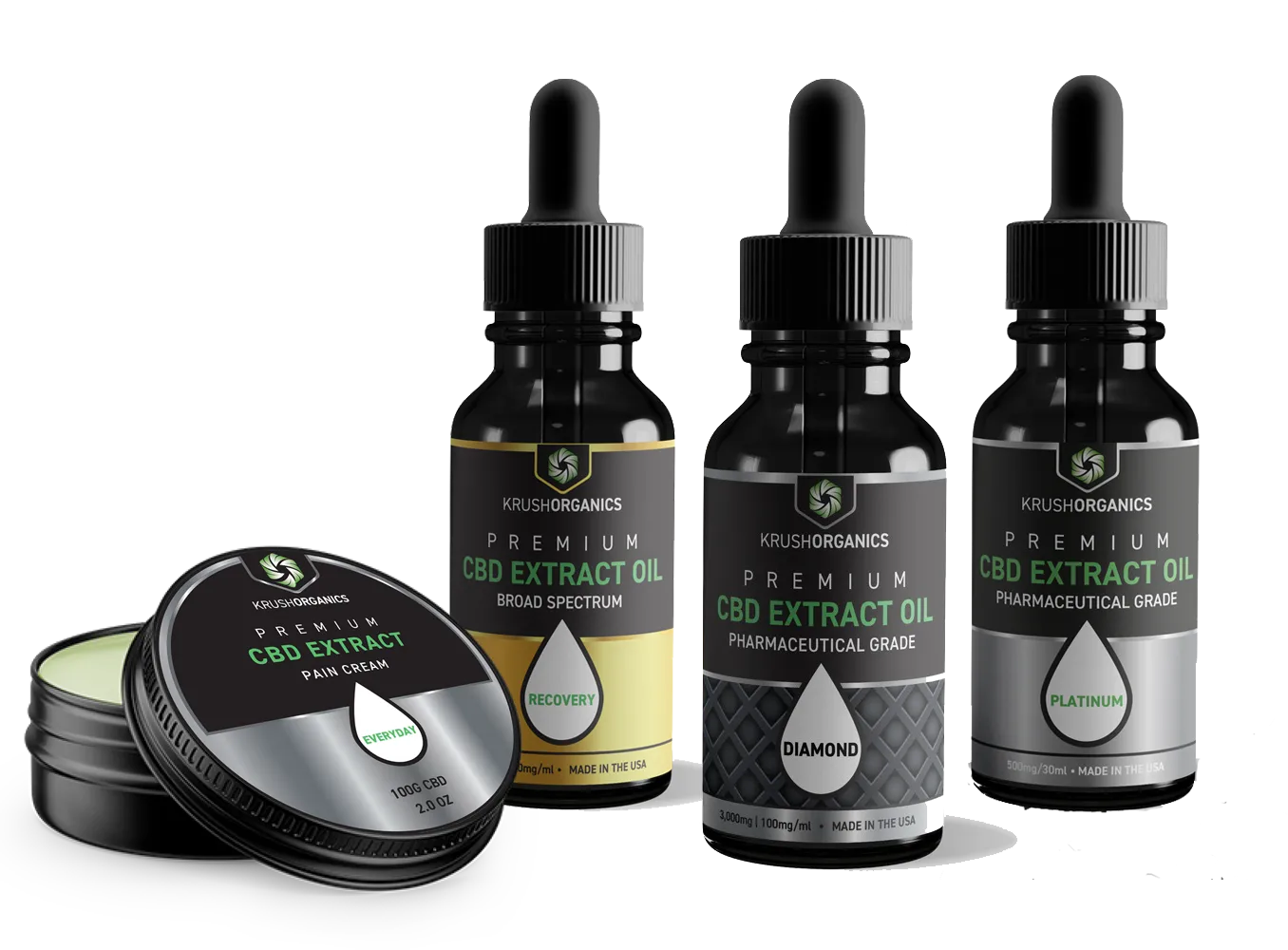
Krush oils & their mg-per-drop math
Once you know your target dose, the next step is converting it into drops. Every Krush oil lists total mg of CBD per 30 ml bottle on the label. Divide that by 30 to get mg per millilitre, and again by 20 to get mg per drop (one drop is roughly 0.05 ml). The table below does the math for the main Krush range.

| Product | Total CBD (per 30 ml bottle) | mg per full dropper (1 ml) | mg per drop (~0.05 ml) |
|---|---|---|---|
| Krush Daily (isolate) | 1,000 mg | ~33 mg | ~1.7 mg |
| Krush Night Time (isolate) | 1,000 mg | ~33 mg | ~1.7 mg |
| Krush Recovery (broad-spectrum) | 1,500 mg | ~50 mg | ~2.5 mg |
| Krush Platinum (full-spectrum) | 1,500 mg | ~50 mg | ~2.5 mg |
| Krush Diamond (broad-spectrum) | 3,000 mg | ~100 mg | ~5 mg |
Practical examples: a 10 mg starting dose of Krush Daily is roughly 6 drops; a 25 mg evening dose of Krush Recovery is roughly 10 drops; a 25 mg dose of Krush Diamond is just 5 drops. Higher-mg bottles like Diamond mean fewer drops per dose — which is why higher-strength formulas tend to be the better-value option once you’ve found your responsive dose.
Start here — the three formulas most people begin with
If you’re new to CBD and matching a formula to your goal, these are the three Krush oils most Australians start with. Every bottle is lab-tested by an independent ISO-accredited facility with full Certificate of Analysis traceability per batch, and delivered tracked anywhere in Australia.

Krush Daily
Light daily dose — 1,000 mg, isolate, zero THC.
$160 · 30 ml

Krush Night Time
Sleep dose — 1,000 mg, isolate, 30 min before bed.
$160 · 30 ml

Krush Recovery
Post-training dose — 1,500 mg, broad-spectrum.
$180 · 30 ml
Can you take too much CBD?
CBD has a well-established safety profile in clinical and observational research. There is no clinically meaningful overdose risk at consumer wellness doses — and the World Health Organization’s 2018 review specifically concluded CBD is well tolerated and non-addictive. That said, “well tolerated” does not mean “no side effects” — and stacking CBD with prescription medication can change how those medications behave.
What “too much” actually feels like
If you’ve taken more CBD than your body responds well to, the most commonly reported effects are drowsiness, dry mouth, mild lightheadedness, and mild GI changes (looser stools or a slightly upset stomach). None of these are dangerous at consumer wellness ranges. They typically resolve within a few hours as the dose clears your system — and they’re a clear signal to drop back to a lower amount next time.
Interactions with prescription medication
CBD is metabolised through the CYP450 liver pathway — the same pathway that processes a wide range of prescription medications, including anticoagulants (e.g. warfarin), anti-epileptics, some antidepressants, and certain sedatives. If you take any prescription medication, especially anything on a narrow therapeutic window, speak with your GP or pharmacist before starting CBD. They can flag interactions specific to your medication and adjust monitoring if appropriate.
Pregnancy, breastfeeding & children
CBD use during pregnancy and breastfeeding is not recommended without medical supervision — the safety data simply isn’t there. We also do not recommend CBD for children without GP supervision; paediatric CBD use sits squarely in the prescription pathway, not the OTC consumer category. If you’re managing a paediatric condition where CBD has been raised, that conversation belongs with a GP or paediatrician.
Is CBD oil legal at these doses in Australia?
Yes — within the Schedule 3 framework. Low-THC, hemp-derived CBD oil at or below 150 mg/day is legal to buy without a prescription in Australia. Above that daily threshold, or for any meaningful-THC formulation, you move into Schedule 4 territory and need a prescription via a GP, an Authorised Prescriber, or the TGA’s Special Access Scheme (SAS-B). The pathway is well-trodden but slower and more expensive than direct-to-consumer purchase.
Krush operates in the legal direct-to-consumer hemp category. For the full legal breakdown, see our CBD legality guide and where to buy CBD oil in Australia. For TGA’s own framing on medicinal cannabis, the Healthdirect medicinal cannabis page is the official starting point.
Frequently asked questions
Reminder: the answers below are general information, not medical advice. Speak with your GP before starting CBD if you take prescription medication, are pregnant or breastfeeding, or are managing a medical condition.
How much CBD oil should I take for sleep?
The most commonly published starting range for sleep is 10–25 mg taken sublingually 30–45 minutes before bed, scaling up by 5–10 mg every 3–5 nights until you reach a level that supports your wind-down. Krush Night Time is the isolate-based formula most often used for this window. For a deeper sleep-specific protocol, see our CBD for sleep guide.
How much CBD oil should I take for anxiety?
Common starting points for stress and everyday anxiety sit at 10–20 mg taken sublingually in the morning, with some users titrating up to 25–40 mg daily as a maintenance baseline. Around acute stress moments — a presentation, a flight — a 5–10 mg dose 20–30 minutes ahead is the most common timing pattern. See our CBD for anxiety guide for more.
How much CBD oil should I take for pain?
For muscle soreness and post-exercise recovery the commonly published starting range is 15–25 mg sublingually post-training, scaling up by 5–10 mg every 3–5 days. Topical CBD cream applied locally is often stacked with oral CBD for a combined approach. For diagnosed clinical pain conditions, dose is something your GP should manage. See our CBD for pain guide.
Can you overdose on CBD oil?
There is no clinically meaningful overdose risk on CBD at consumer wellness doses. Clinical research has used doses up to 1,500 mg/day with no severe adverse events, and the WHO 2018 review concluded CBD is well tolerated and non-addictive. That doesn’t mean side effects are zero — taking more than your body responds well to causes drowsiness, dry mouth and mild GI upset, none of which are dangerous.
What happens if I take too much CBD?
The most commonly reported effects of taking more CBD than you respond well to are drowsiness, dry mouth, lightheadedness, and mild gastrointestinal upset (looser stools, slight stomach unease). These resolve within a few hours as the dose clears your system. Drop back to your previous responsive dose next time. If symptoms persist or feel severe, contact your GP.
How long until I feel CBD oil working?
Sublingual CBD oil typically takes 15–30 minutes to start working, with peak effect at 60–90 minutes and total duration of 4–6 hours. Swallowed CBD (capsules, gummies, oil with food) takes longer to onset — 45–90 minutes — but lasts 4–8 hours. Daily users often build a steadier baseline level over 1–2 weeks of consistent use.
How often can I take CBD oil?
Most people take CBD oil 1–3 times per day, depending on goal. A common pattern is a small morning dose for focus, a small daytime dose around a stress trigger, and a larger dose 30–45 minutes before bed. Total daily intake commonly sits between 10 mg and 150 mg — within the Schedule 3 over-the-counter ceiling in Australia.
Can I take CBD oil every day?
Yes — daily use at typical wellness ranges is the most common usage pattern, and the safety profile supports it. Many users build a steadier baseline effect over 1–2 weeks of consistent daily dosing. As always, if you take prescription medication speak with your GP first — and if a daily routine doesn’t suit your goal, sub-daily or as-needed use is also fine.
Should I take CBD oil with food?
Taking CBD oil with a meal — particularly one containing dietary fat — generally improves bioavailability and can produce a more pronounced effect. Sublingual dosing (held under the tongue) bypasses some of this and works fine empty-stomach. If you find your effect feels mild, try the same dose with a small fat-containing snack and compare.
Can I split my CBD dose across the day?
Yes — splitting your total daily CBD across 2 or 3 smaller doses is one of the most common usage patterns and often produces a steadier effect than one large dose. A typical split might be 10 mg in the morning + 15 mg pre-bed, or 5 mg AM + 10 mg midday + 15 mg PM. Find the split that matches your day.
Can I give CBD oil to my kids or pets?
Kids: we do not recommend CBD for children without GP supervision. Paediatric CBD use sits in the prescription pathway, not the OTC consumer category — that conversation belongs with your GP or paediatrician. Pets: CBD for pets uses pet-specific formulations and pet-specific dosing logic. See our CBD oil for dogs guide and the Krush Pet Infusion product page.
Start low. Go slow.
Pick the Krush formula that matches your goal, start at 5–10 mg, and work up over a couple of weeks. Every bottle, every batch — lab-tested. Tracked delivery to your door anywhere in Australia.
The information in this guide is general in nature and does not replace personalised medical advice. The dosing ranges shown are common starting points published across the CBD wellness category — not prescriptions. Individual response varies. Always speak with a qualified healthcare professional before starting any CBD product, especially if you take prescription medication, are pregnant or breastfeeding, are managing a medical condition, or are considering CBD use for a child. CBD products are not intended to diagnose, treat, cure or prevent any disease.
Please note: The information provided in this article is based on general research and is not intended to replace professional medical guidance. Always speak with a healthcare professional before using CBD products, especially if you are pregnant, nursing, or managing a medical condition.